An early change in melasma and a change that lasts are related questions, but they require different observations. A study can describe improvement at a visit without showing when it began, whether it persisted between visits or what happened after the observation period ended. The date attached to a result is therefore part of its meaning, rather than a detail that can be dropped from the headline.
Tone Notes examines this sunscreen study. The central question is what a sequence of measurements tells us about the course of a condition. We then connect that question to evidence about an initial prescription-cream response and to the separate decision about maintenance. This is an interpretation of research time windows, not a schedule for an individual to start, change or stop treatment.
Study facts at a glance
- Participants: 42 women randomized, 21 per group. [1]
- Duration: Five months; southern France, during summer. [1]
- Primary measure: Instrumental colorimetry. [1]
- Secondary: Modified Melasma Area and Severity Index (mMASI). [1]
- Completion: 41 completers; one pregnancy withdrawal. Final arm counts unreported. [1]
The starting point changes the follow-up question
Time since beginning an intervention and time since achieving control are not necessarily the same clock. The first can help describe an initial response; the second can help investigate whether that response lasts. If researchers want to study recurrence, they also need a clear state from which a return of disease can be recognized. A duration alone does not identify which of these questions was answered.
The table below is an editorial framework for keeping those questions distinct. It does not impose a treatment schedule or describe additional study findings. Its purpose is to show why an endpoint at a particular visit cannot silently become a claim about the whole interval. A person’s condition between observations, and after the final observation, requires evidence of its own.
This distinction can make a clinical conversation more precise. Is the aim to understand a first response, establish the current state or investigate a return after earlier control? Our guide to melasma maintenance as a separate decision develops that care question. In this article, the research interpretation remains attached to the relevant starting point and measurement, so a promising result does not acquire a longer duration than the study actually observed.
| Question | Time reference | Observation needed |
|---|---|---|
| Initial response | Beginning the intervention | A defined change from the starting state. |
| Status at follow-up | A specified assessment visit | The clinical or instrumental state at that visit. |
| Durability or recurrence | An explicitly defined state of control | Whether and when that state is maintained or lost. |
The sunscreen comparison followed a defined group and formula
Participants were aged 28–58 with phototypes III–IV; investigators were blinded. Bioderma Photoderm M SPF50+ Golden (pVL 66) was compared with an untinted formula offering similar UV protection. pVL denotes visible-light protection factor. A protection factor is a product characteristic. It should not be interpreted as the proportion of people who will achieve a clinical response.
These details establish the context in which the observations were made. Allocation can support a comparison within that context, while the product descriptions keep the result attached to the preparations tested. They do not make a similar-looking cream interchangeable, and they do not make the enrolled population representative of every person seeking pigment care. Applying a finding elsewhere requires a separate judgment about relevance.
Our interpretation also distinguishes the diagnosis under study from the appearance of a concern. A familiar photograph or a shared descriptive phrase is not enough to establish that the same condition is present. The guide to melasma and other dark spots helps frame that preliminary question. Once the concern is identified, the research can be considered for its actual population, product and follow-up period instead of being used as a shortcut around assessment.
Scheduled measurements reveal only part of a trajectory
Assessments preceded application at baseline, 2.5 and five months. A schedule like this creates a set of observations through time. It does not continuously record the condition. The distinction is important when a description changes from what was observed at the visits to what was supposedly true throughout the entire study period.
Consider two hypothetical courses with the same beginning and ending measurements. One could change gradually; the other could improve early, fluctuate and return to the same final value. The endpoints alone would not distinguish them. This is an example of what sparse observations leave unresolved, not a claim that either course occurred among the trial participants. Additional observations would be needed to describe the path more fully.
Repeated measurements also come from the same people, rather than creating a new independent group at every visit. A suitable analysis should recognize that relationship. Our reading does not infer the full statistical method from the existence of several assessment dates. It uses the published short report and preserves the boundary around its unexamined supplement. The useful conclusion is that timing and analysis together determine how much of a trajectory a study can establish.
Color uniformity is a relationship between measured areas
Contrast between affected and adjacent skin improved significantly within the tinted arm, not within the untinted arm. These observations raise a distinct scientific question: how does a difference between areas relate to the absolute condition of each area and to a clinician’s assessment?
As a reasoning example, imagine measuring a lightness gap on two occasions. An unchanged gap could coexist with changes in both areas if they moved by the same amount. A narrowing gap could arise from unequal changes. The gap is informative, but it does not contain every fact about the underlying measurements. Interpreting it as a complete account of disease would discard information about the components from which it was calculated.
The same distinction matters over time. Persistence of a smaller color difference is not automatically persistence of clinical clearance. That connection would need to be investigated with defined outcomes rather than assumed from the word improvement. Our guide to light protection in a melasma plan supplies related context. Here, the scientific reading keeps optical contrast, the clinical state and a person’s experience as connected but separately measured questions.
Clinical scores describe another aspect of follow-up
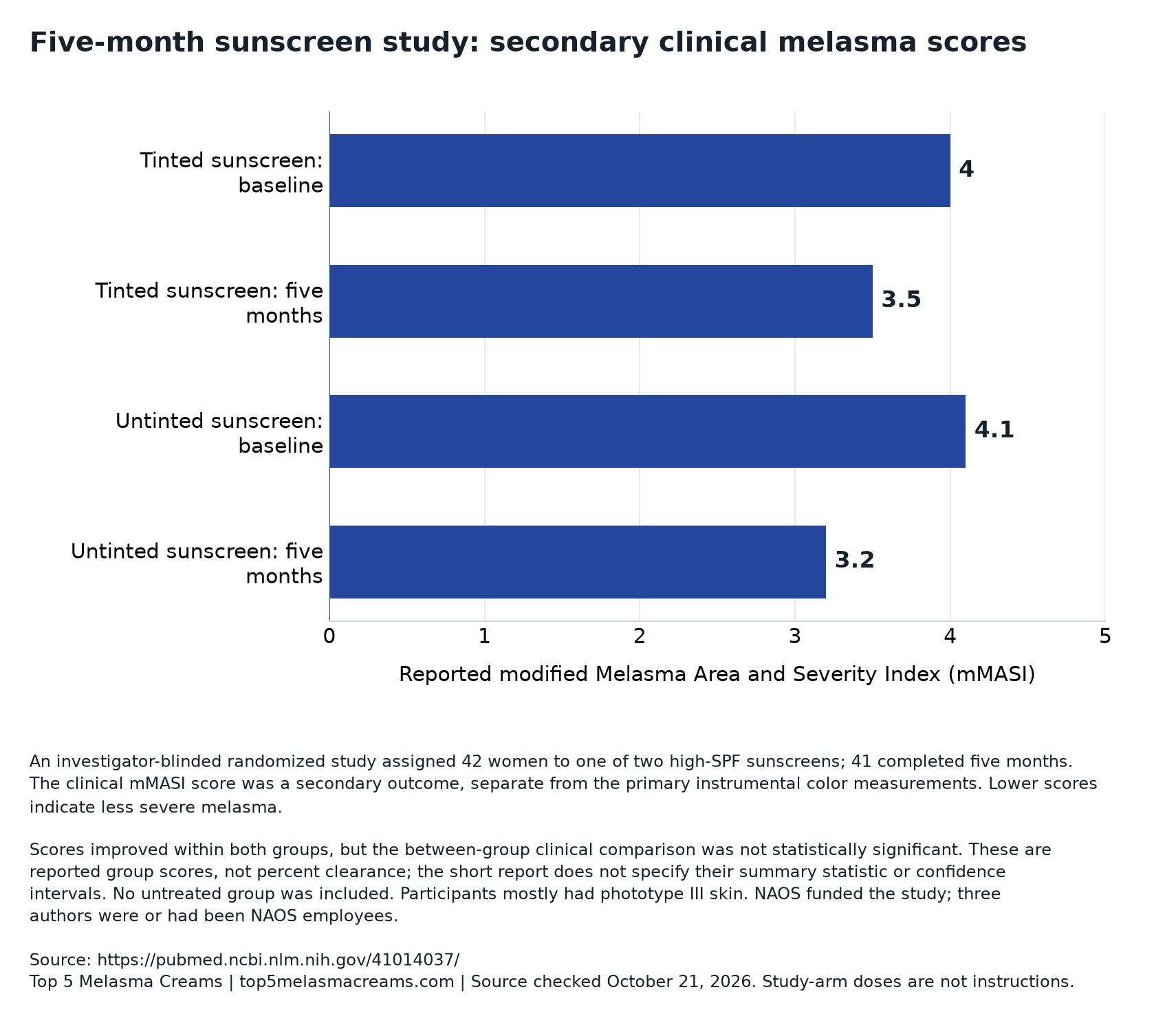
Both within-group P values were <0.001; the between-group comparison was nonsignificant. The summary statistic was unspecified. Those results describe changes and a comparison on the clinical scale. They do not identify how many people reached a separately defined response threshold.
A score and a response count differ in their construction. Counting responders requires a rule and individual outcomes classified under it. A group-level score may conceal substantial variation in individual courses. It cannot tell a reader whether everyone changed similarly or a smaller number changed more. The display preserves the available figures without inventing that distribution or describing them as averages when the report does not do so.
The time interpretation is equally limited. A lower score at follow-up describes the observed state at that assessment, not a guarantee about the next interval. A useful clinical discussion can ask what change would be meaningful and how it would be recognized again. Those are questions about interpreting and observing an outcome, not a reason to convert the chart into a personal probability of lasting benefit or a forecast of what happens after treatment changes.
| Preparation | Starting value | Final value |
|---|---|---|
| Tinted | 4.0 | 3.5 |
| Untinted | 4.1 | 3.2 |
Durable control needs more than a favorable final visit
The trial lacked an untreated control and had baseline imbalances. These design considerations affect different inferences. The missing untreated comparison limits estimates of absolute prevention against no intervention. Different starting values matter when interpreting how groups change. Neither issue is resolved simply by extending the wording of a final-visit result into a claim of sustained protection.
A within-group test asks whether observations changed within that group. Comparing treatments requires a test of the relevant difference between groups. One change reaching a significance threshold while another does not is insufficient to establish a treatment difference. A confidence interval around an appropriate contrast would help express its precision; numerical intervals have not been reconstructed here from the figures or from an unspecified summary statistic.
For a durability question, the event rule matters as much as the statistical method. Researchers would need to define the state being maintained, what constitutes its loss and how often participants are assessed. A return identified at a scheduled visit may have begun earlier, while an unobserved fluctuation may leave no trace in the final value. These are methodological possibilities that show what additional evidence is needed, rather than explanations asserted for the study’s results.
An eight-week cream response answers an earlier-stage question
A separate Chinese triple-combination study reported eight-week responses in 12/23 generic-cream recipients and 12/21 Tri-Luma recipients, using a two- or three-grade decrease on the Melasma Severity Scale. That criterion measured a severity-grade improvement; it did not require complete clearance. The detailed eight-week trial analysis examines its population, comparison and response definitions separately from the sunscreen experiment.
The US Tri-Luma label provides another time-specific observation: of seven participants clear at week four, four did not retain remission after four more weeks of treatment. This small selected group is not a population-wide recurrence estimate. It illustrates why an initial state and its later persistence need distinct observations, even when treatment continues. It should not be described as an effect of stopping treatment.
Methodologically, a trial can establish a response threshold at one time without establishing how long each response lasts. To study duration, investigators would need to follow the relevant responders and define the next event. Adding a later study of another intervention does not join the participants into one continuous course of care. The two research records can inform different questions, while the gap between early response and lasting control remains a question for appropriate follow-up evidence.
Maintenance introduces a new decision and a new evidence requirement
Tri-Luma labeling describes short-term treatment of moderate-to-severe facial melasma, excludes maintenance use and states that recurrence is usual after discontinuation. These are prescribing boundaries. They do not specify a personal transition plan or establish that another product can replace the medicine while preserving an individual response.
Our interpretation is that a change in care creates a fresh question about the resulting course. To examine that question scientifically, a study would have to describe the starting state, the new strategy, any continuing measures and the outcome being followed. Without that information, the effect of one element cannot be separated from the overall context. This is a framework for evaluating evidence, not an instruction to change any part of treatment.
The guide to hydroquinone supervision discusses the clinical questions that need identifiable answers. A person can ask what result is being monitored and what uncertainty remains without assuming that every study supports the same phase of care. For research interpretation, the practical distinction is between evidence about obtaining an initial response and evidence about retaining a defined state. Keeping those questions separate makes a maintenance discussion more specific and avoids extending a short observation into an indefinite promise.
Safety observation also has a time window
Both products were described as well tolerated; event counts unreported. NAOS Ecobiology Company funded the study. Three authors disclosed current/former NAOS employment; Passeron disclosed industry honoraria. The Chinese trial separately received support from the Scientific Research Fund of Zhejiang Provincial Education Department and Zhejiang Fonow Medicine, including manufacturer-supplied products; its authors declared no conflicts.
A safety description has limits imposed by its observation period, population and method of collecting events. It cannot supply a frequency without suitable counts, nor reliably characterize uncommon experiences merely because the follow-up was completed. Our interpretation keeps a favorable description distinct from an estimate of risk. A question about longer use would require observations designed to address that longer exposure.
The Tri-Luma label identifies irritation, hypersensitivity, ochronosis and possible systemic corticosteroid effects. Those warnings belong to the medicine and should not be presented as sunscreen events. Funding relationships also belong to their respective studies: they provide context for scrutiny of design, reporting and access to data, rather than an explanation for any participant’s course. A careful longitudinal reading keeps the duration of observed experience, the regulatory safety record and the documented research relationships visible together.
Keep the follow-up question attached to the actual care record
FDA states that OTC hydroquinone skin-lightening products lack approval for safety and effectiveness and describes reports of rash, facial swelling and potentially permanent ochronosis. This notice is separate from the approved prescription Tri-Luma record. It does not establish the status of an unspecified compounded product or assign mercury contamination to an untested preparation.
Our editorial interpretation is to carry the clinical question forward without assuming that a service reproduces a research protocol. Documentary reviews of Musely and Agency can help readers examine the relevant service and product records. These links do not establish access to the trial sunscreen, participation in the research or outcomes matching those of its participants.
A useful care record would make clear what is being observed, the date of the observation and which question is still open. Is the uncertainty about the diagnosis, the exact formulation, the meaning of a score or whether a response has persisted? Naming the question helps direct a follow-up discussion to the information needed. Tone Notes treats that specificity as the practical value of research: evidence can sharpen the conversation without supplying an individualized schedule or guaranteeing the next stage of a person’s course.
What this evidence supports
A time window defines the reach of a result. Each phase of care requires a corresponding definition of the event or state being observed. Our assessment is that these records are most useful when their clocks and outcomes remain distinct. An early change, a later measurement and durable control are not three names for the same finding. Following the evidence through those stages helps a reader identify what has actually been observed and what would need to be learned before making a stronger claim about the future.
Research access and limitations
This analysis uses the full short sunscreen report with its funding footnote, the separate Chinese cream trial, official Tri-Luma labeling and FDA’s consumer notice. It does not claim review of the sunscreen supplement or reconstruction of numerical plot estimates and confidence intervals. Hypothetical trajectories and research requirements are methodological explanations, not additional participant outcomes.
Your questions, answered
Does improvement at a final visit demonstrate continuous control?
It establishes the observed state at that visit, subject to the study’s design and analysis. Continuous control is a stronger statement about the intervening period. Our methodological interpretation asks what observations or event rules would support that additional claim, rather than assuming the spaces between visits were measured. [1] [2]
Why distinguish time since starting care from time since responding?
Those clocks answer different questions. The first can describe an initial change, while the second can help study persistence after a defined response. A recurrence analysis also needs an explicit starting state. Without that distinction, follow-up durations that look similar may refer to different clinical situations. [1] [3] [2]
Can a more uniform color measurement stand in for clinical clearance?
It cannot establish that equivalence by itself. A contrast measurement describes a relationship between skin areas, whereas clearance requires a clinical definition. Research could evaluate how those outcomes relate, but their connection should be demonstrated rather than assumed from a shared description such as improvement. [1] [2]
What makes a future maintenance study more informative?
Useful features would include a clearly defined initial state, a specified continuing strategy, an appropriate comparison and transparent rules for identifying loss of control. Reporting the timing and uncertainty of outcomes would help interpret duration. These are proposed research features, not findings or personal treatment instructions. [1] [2]
How should a provider review use this research?
Our editorial view is that the research should clarify the question and its evidence limits. A review can separately document a provider’s offer and follow-up terms. It should not imply that a published trial verifies the service’s clinical outcomes or guarantees a particular person’s response over time. [1] [3] [2]
Sources & further reading
Provider pages establish what a brand markets. Clinical and regulatory sources establish the limits of the evidence. Each source has its own last-checked date below.
- Comparison of Visible Light-Protective Tinted Sunscreen to Untinted Sunscreen to Protect Melasma Patients During Summer: A Prospective Randomized Investigator-Blinded Study.Full primary research letter plus verified PMC funding footnote; supporting-information document and figure-derived numerical data not reviewed · Checked October 21, 2026
- DailyMed: current TRI-LUMA prescribing informationFull official prescribing information · Checked October 21, 2026
- Efficacy and Safety of Generic Fluocinolone Acetonide, Hydroquinone, and Tretinoin Cream Compared With TRI-LUMA for the Treatment of Moderate-To-Severe Melasma in Chinese Patients: A Randomized, Single-Center, Placebo-Controlled Trial.Full research article, with indexed abstract where available · Checked October 21, 2026
- FDA: warnings about skin-lightening productsCurrent FDA consumer safety notice, introductory safety text read; individual product-testing table is not used for provider comparisons. · Checked October 21, 2026