A cream can produce a measurable response during a study without answering how long that response will last. For melasma, reading the treatment calendar is therefore part of reading the result. The first question is what changed while participants were being treated. A second question is what happened after the treatment decision changed. Combining those questions into a single promise of lasting improvement asks the evidence to cover time it may never have observed.
This analysis follows the boundary between those questions through a randomized triple-combination cream study, the US TRI-LUMA prescribing information and a separate sunscreen experiment. The purpose is to understand which measurements could support an initial treatment decision and which additional observations would be needed to evaluate durable control. That distinction also helps explain why a clinical severity score, a color measurement and an ongoing care arrangement should be evaluated separately.
Study facts at a glance
- Study formulation: Topical hydroquinone 4%, tretinoin 0.05% and fluocinolone acetonide 0.01%; study identification only. [1]
- Response and duration: Meeting a response criterion at a visit does not measure how long that response persists. [1] [2]
- Meaning of improvement: A change in severity and a final state of complete clearing answer different questions. [1] [2]
- Maintenance boundary: The US label specifies short-term treatment, excludes maintenance use and notes usual recurrence after discontinuation. [2]
- Evidence to request: A durability claim needs a defined starting response, subsequent treatment conditions and follow-up outcomes. [1] [2] [3]
Locate the trial on the treatment calendar
This randomized, double-blind Chinese report describes one center, not its 320-person parent trial. Allocation was 24/21/8 (generic/TRI-LUMA/placebo), totaling 53, mostly women with epidermal melasma, aged 33–55.
The useful interpretation begins with the sequence: establish a starting condition, assign treatment, then measure a later condition. Random assignment helps the comparison address what happened under the assigned alternatives. It does not extend the observation period beyond the last assessment or turn a change during treatment into a prediction about a future period without it. The time boundary remains part of the result even when the improvement is substantial. That separation changes the information needed even if the same person participates in both phases.
Consider two possible research questions: whether a treatment helps someone reach a better state, and whether that better state remains stable after the treatment changes. They require different starting points. The first begins before improvement; the second begins after a defined response. Before applying either question to a particular mark, the guide to melasma and other dark spots explains why establishing the condition matters.
Read the response rule before the percentage
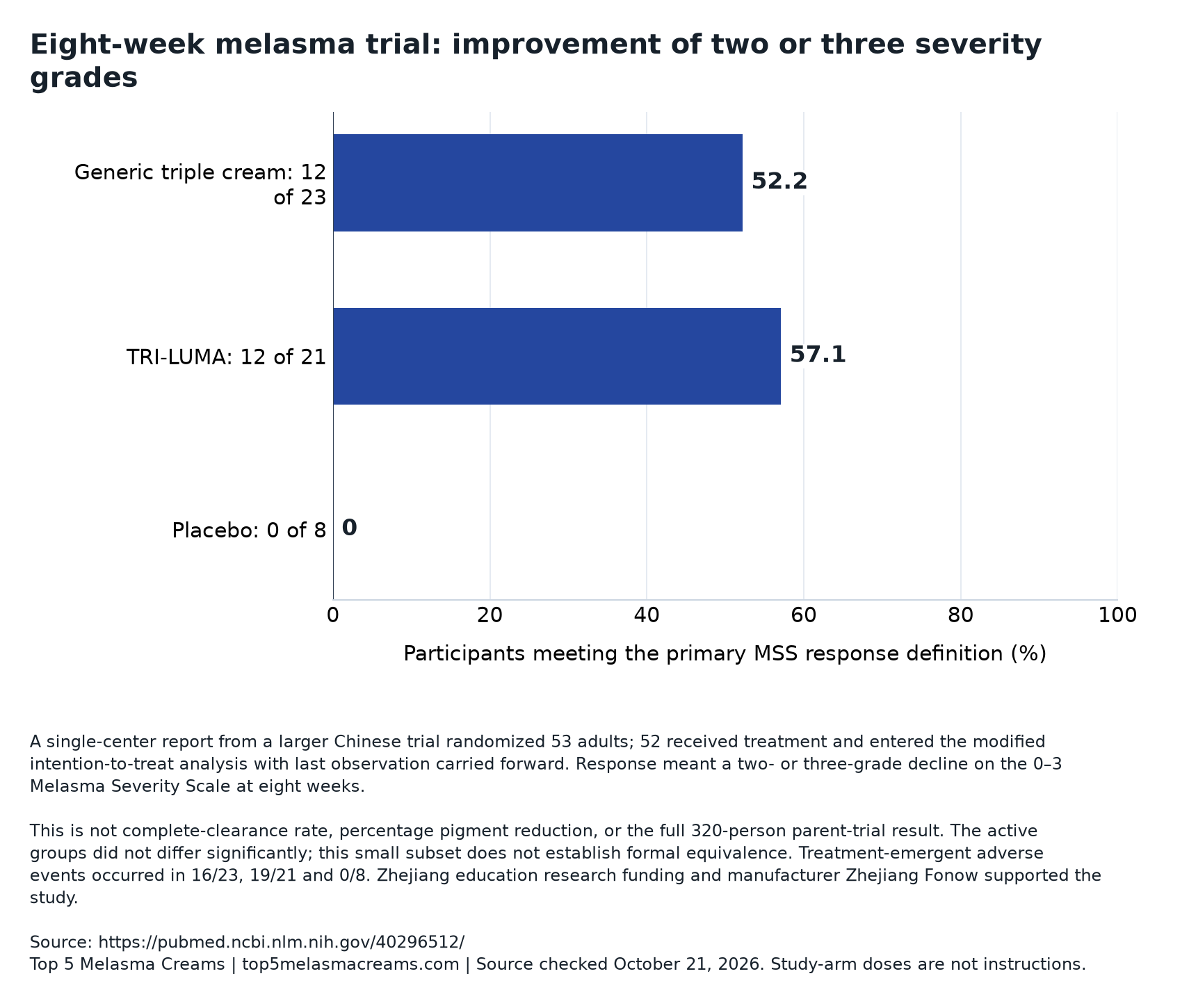
The primary outcome was an eight-week Melasma Severity Scale (MSS) decrease of two or three grades, on a 0–3 scale. The table’s percentages count people meeting a rule. Counting people and measuring pigment are different operations: a proportion of responders cannot be interpreted as a percentage of pigment removed.
A simple illustration shows why the rule matters. On this scale, moving from grade three to grade one is a two-grade improvement. Moving from grade two to grade zero also spans two grades. Both satisfy the change rule, although the final states differ. This is arithmetic about the endpoint, not a reconstruction of individual participants. A responder category can deliberately group different final appearances because it measures movement from the starting state.
By contrast, the label’s separate trials counted MSS zero as success, with TRI-LUMA results of 32/85 and 10/76. Those trials compared three dual-active combinations. Comparing their headline percentages with the table would therefore combine different questions. A shared assessment date cannot make a change threshold and a final-state threshold interchangeable. First specify the event being counted, then consider its frequency.
| Assigned cream | Responders / analyzed participants | Reported response |
|---|---|---|
| Generic triple combination | 12/23 | 52.2% |
| TRI-LUMA | 12/21 | 57.1% |
| Placebo | 0/8 | 0% |
Separate observed follow-up from carried-forward scores
One generic recipient was untreated; 52 were analyzed, with last observations carried forward. Completers totaled 44 (18/19/7 by arm).
That method substitutes an earlier recorded value when a later observation is absent. An illustrative participant who improved before missing a visit might have remained stable, improved further or worsened afterward. Carrying the score forward selects one representation for analysis; it does not reveal which unobserved trajectory actually occurred. Nor does a filled spreadsheet cell become an additional examination. This distinction is especially consequential when the question concerns persistence over time.
An analysis including people with incomplete follow-up and an analysis restricted to completers can answer different practical questions. Restricting attention to those who remain may discard experiences relevant to treatment acceptability. Including earlier observations introduces assumptions about missing outcomes. Neither choice can restore an unmeasured future. To assess durability, readers would want to know when follow-up ended, why observations were missing and whether conclusions changed under alternative plausible assumptions. Those are requests for stronger evidence, not a claim that every missing outcome was unfavorable or that the reported treatment response should be ignored.
Distinguish a response threshold from the size of change
Secondary analyses also used MASI, the Melasma Area and Severity Index. A score can support a threshold that classifies people as responders, or a calculation summarizing the size of change. These summaries describe different features of a distribution.
For illustration, imagine five people whose scores decrease by 20%, 20%, 20%, 20% and 70%. Their mean reduction is 30%, while one person reaches a 50% threshold. Another imaginary group improves by 30% each: the same mean, but nobody reaches that threshold. Neither example is trial data. It demonstrates why the average improvement cannot identify how many individuals crossed a particular boundary. A useful report can present both without requiring their percentages to agree.
There is a further distinction between variation among participants and uncertainty about an estimate. A standard deviation describes spread in the observed values; a confidence interval addresses precision under a statistical model. Printing one beside a mean does not substitute for the other. For a question about lasting control, even a precisely estimated average at one visit would still leave the later trajectory unknown. Precision can strengthen an answer to the measured question, but cannot change what question the measurement was designed to answer.
Keep the comparison tied to the surrounding care
Cleanser, moisturizer and sunscreen were shared background care. Active-arm efficacy differences were nonsignificant. This report does not establish formal equivalence.
The surrounding care defines the setting in which a treatment contrast is interpreted. If the background is shared, the comparison concerns the alternatives within that background. It does not separately estimate what each supporting component contributed or reproduce a setting in which those components are absent. A product name alone is therefore an incomplete description of the experiment. The care conditions belong in the account alongside the cream.
Equivalence asks a different statistical question from a conventional test for a difference. It needs a justified margin for an acceptably small difference and enough precision to evaluate that margin. Failure to detect a difference can arise when uncertainty remains wide; it does not itself place the entire plausible difference inside an equivalence boundary. This matters when moving from research to a service comparison. The CoreAge Rx review can serve as a place to examine documented service terms, but a trial of a formulation does not establish that a particular service supplies the studied treatment, reproduces its care conditions or achieves its outcomes.
Define a fresh starting point for maintenance research
A durability study needs to say when its clock starts. Starting at the first prescription includes the effort required to achieve improvement. Starting only after a response selects a different group: people who have already met a criterion. Their later outcomes cannot be used as though they describe everyone who originally sought treatment. The definition of entry into the maintenance phase is therefore as important as its length.
The table sketches possible research designs rather than findings from these studies. Each design preserves information that a single final photograph would lose. For example, an end-of-study score cannot distinguish someone who remained stable throughout from someone who worsened and later recovered. Repeated assessments or a defined time-to-event outcome could separate those patterns, provided the event and assessment schedule were specified in advance.
The practical interpretation is to ask what later decision the evidence can inform. Continuing one treatment, switching treatments and observing after withdrawal are different comparisons. None should be silently inserted into a trial that did not evaluate that transition. The melasma maintenance guide develops this separate decision without turning an initial response rate into a standing prescription.
| Question | Starting point to define | Outcome to follow |
|---|---|---|
| Does improvement persist after a transition? | A specified response before treatment changes | Repeated severity assessments under the new conditions |
| How long until a defined recurrence? | A clearly documented controlled state | Time to the prespecified recurrence threshold |
| How often is additional treatment needed? | A stated follow-up strategy | Additional interventions and the reasons for them |
Give adverse events their own observation window
Treatment-emergent adverse events: generic 16/23, TRI-LUMA 19/21, placebo 0/8. Irritation differed significantly (12/23 versus 17/21); one TRI-LUMA recipient withdrew with exfoliation. Atrophy and telangiectasia were unobserved over eight weeks.
Those observations require two separate readings. An overall event category combines experiences that may differ in severity, duration and effect on participation. A difference in one named event cannot establish superiority across that combined category. Equally, the absence of a particular event in a short study does not establish that it cannot emerge during a longer exposure. The observation window limits both benefit and harm claims.
The US label warns about sulfite hypersensitivity, blue-black ochronosis, systemic corticosteroid effects and irritation; pregnancy requires clinician discussion. These concerns are not interchangeable with a tally of short-term symptoms. A useful safety assessment distinguishes what was observed, what the label identifies and what remains uncertain for a proposed treatment period. The guide to hydroquinone supervision turns that distinction into questions about clinical oversight. It cannot provide a personal continuation or stopping rule from group averages, because individual circumstances were not determined by those averages.
Use light measurements to answer a light-measurement question
A separate five-month randomized sunscreen study included 42 women, with 41 completing. Its primary measurements assessed color, while clinical mMASI was secondary. Both groups improved clinically without a significant between-group mMASI difference.
Instrumental color contrast and a clinical severity score describe different aspects of appearance. A comparison between affected and adjacent skin focuses on their relationship; a clinical assessment can incorporate a broader judgment of the affected area. An illustrative reduction in contrast could arise through changes in either region, so the components deserve attention as well as their difference. This is a measurement principle, not a claim about an unreported mechanism in the study.
A later endpoint in a different experiment does not extend the earlier cream trial. Different participants, interventions and outcomes cannot be joined into a continuous patient timeline. The five-month sunscreen analysis examines those measurements more closely. The melasma sun-protection guide supplies related context. Reading them alongside the cream evidence can broaden the questions considered in care, but cannot establish that the tested sunscreen preserves a particular cream response or quantify recurrence prevention against no sunscreen.
Translate the evidence boundary into a care question
The US label has not established safety and efficacy for phototypes V–VI or other hyperpigmentation conditions. FDA separately states that no OTC skin-lightening products are FDA-approved or legally marketed; it reports rashes, swelling and potentially permanent ochronosis with hydroquinone-containing lighteners.
Those statements address different categories. A prescription label defines a particular approved product, while a regulatory notice addresses a separate market and reported harms. Neither source determines the status of an individual compounded preparation. Similar ingredient language on a website cannot resolve formulation identity, regulatory status or whether the evidence applies to the condition being assessed. Those require their own documentation.
As an editorial interpretation, a useful care comparison separates the initial evaluation, the response assessment and the later follow-up decision. The Musely review can help locate documentary terms for examination without implying that its service was studied here. The melasma care budget guide offers a framework for asking which visits and changes are included. No trial percentage supplies an annual cost or the number of future consultations. Those practical questions matter precisely because an initial treatment period and ongoing care are different commitments.
Ask what the next study would have to observe
Zhejiang Provincial Education Department research funding and Fonow supported the cream trial; Fonow supplied products. Authors declared no conflicts. NAOS funded the sunscreen study; three authors were current or former employees, and industry honoraria were disclosed.
These relationships belong beside the methods so readers can examine the evidence with its context intact. Funding neither supplies missing follow-up nor automatically invalidates observed results. The useful response is to ask whether the outcomes, analysis choices and limits are transparent enough for independent scrutiny. A persuasive conclusion should remain proportionate even when the study has a commercial sponsor or the product is familiar.
For the lasting-control question, a stronger design would document an initial response, specify what changes afterward, record repeated outcomes and retain reasons for additional treatment or missing visits. It would also distinguish clinical appearance from instrumental measurements and count adverse experiences over the relevant exposure period. Those are proposed requirements for answering the question, not evidence that such a strategy has already succeeded. The most informative next result would connect a clearly defined transition to a clearly defined later outcome, allowing readers to see both the route to improvement and what happened after it.
What this evidence supports
The scientific value of the cream study lies in a bounded comparison of initial response. Its time window, endpoint and analysis define that value. The separate label and sunscreen evidence add different pieces: product-specific prescribing boundaries and a different way to examine pigmentation during a longer observation period. They should inform a discussion together while retaining their separate questions. Our interpretation is that a useful melasma care plan needs an explicit handoff between assessing improvement and deciding what follows. Research supporting that handoff would identify who responded, what changed next, how outcomes were measured and which additional interventions occurred. Until those observations are available for a particular strategy, initial response and durable control remain distinct claims. Keeping them distinct makes the evidence more useful, because it shows exactly which next question needs an answer.
Research access and limitations
This analysis uses the full cream trial, official US prescribing information, the full sunscreen research letter with its funding footnote, and the current FDA notice. The sunscreen supporting-information document and figure-derived numerical data were not reviewed. These sources do not establish a maintenance regimen, a provider outcome, US availability of the study generic, or a cost comparison.
Your questions, answered
If someone improves at the final visit, does that count as lasting control?
It documents a state at that visit. Lasting control needs a definition of how long the state persists and under which treatment conditions. Imagine two people with the same final score but different later trajectories: the original visit cannot distinguish them. A follow-up study has to observe the period that matters rather than infer it from the strength of the first response. [1] [2]
Would repeating the same photograph later settle the question?
A comparable later image could add information, but an endpoint needs more than a selected photograph. The assessment method, timing, treatment changes and handling of missing observations affect interpretation. Repeated images might support a documented assessment; they do not by themselves show how a whole group performed or whether people needing additional treatment were included in the outcome. [1] [3]
Why not rank the creams by whichever improvement percentage is largest?
The larger number may describe a different event, population or analysis. A mean score change, a proportion crossing a threshold and a proportion reaching a final state cannot be placed on one scale merely because all use percentages. A defensible comparison first aligns the question, comparator and observation period. Only then does the numerical difference become interpretable. [1] [2]
Does a longer sunscreen experiment answer the cream maintenance question?
It answers questions about its own intervention and measurements. Combining studies can identify complementary areas of inquiry, but it cannot create follow-up for people in another experiment. To evaluate preservation of a cream response, researchers would need a design that actually connects that response to the subsequent strategy. That link cannot be supplied by placing two study timelines next to one another. [1] [3]
What is the most useful question to take to a treatment discussion?
Ask how an initial response will be assessed and what evidence will guide the later decision. That invites a distinction between the goal of the first treatment period, the observations needed to judge it and the options to discuss afterward. It also leaves room to consider tolerability and individual circumstances, instead of treating a study average as an automatic personal treatment plan. [1] [2]
Sources & further reading
Provider pages establish what a brand markets. Clinical and regulatory sources establish the limits of the evidence. Each source has its own last-checked date below.
- Efficacy and Safety of Generic Fluocinolone Acetonide, Hydroquinone, and Tretinoin Cream Compared With TRI-LUMA for the Treatment of Moderate-To-Severe Melasma in Chinese Patients: A Randomized, Single-Center, Placebo-Controlled Trial.Full research article, with indexed abstract where available · Checked October 21, 2026
- DailyMed: current TRI-LUMA prescribing informationFull official prescribing information · Checked October 21, 2026
- Comparison of Visible Light-Protective Tinted Sunscreen to Untinted Sunscreen to Protect Melasma Patients During Summer: A Prospective Randomized Investigator-Blinded Study.Full primary research letter plus verified PMC funding footnote; supporting-information document and figure-derived numerical data not reviewed · Checked October 21, 2026
- FDA: warnings about skin-lightening productsCurrent FDA consumer safety notice, introductory safety text read; individual product-testing table is not used for provider comparisons. · Checked October 21, 2026